
This is not going to be a short topic. Where do I begin?
I suppose it started in the summer of 2023, while I was seeing a therapist who was working with me through the darkest days of my life. Her name was Anna, and that is perhaps one of the reasons I felt God matched us up for this season. As far as biblical women go, I always felt I related most to the spirit that Anna had, one of contending and intercession, and I prayed I would be like her, full of zeal when in my old age.
The therapist, after listening to me week after week, made a suggestion that I listen to this podcast by Adam Young on “grief and sorrow.” Now, at this time I was so completely out of my mind, and I mean that in the most honoring way toward myself, but to understand the context, I was grasping at straws of reality. I felt like there were winds coming against my head from every direction. Voices: “Who am I?” “Where am I?” “Where did I come from?” “Where am I going?” “What happened to me?”
It was at this time I was divorced, living on my own for the first time in 25 years. My mom had recently passed. I was out of (professional) ministry, the only “career” I had known, and completely isolated, as all of my friends were connected to the ministry I would no longer be associated with. I had two friends, that’s all. Just two who talked to me. I would have panic attacks every time I left the house, every time my phone rang, and every morning I would wake up in a sweat reciting an anchoring mantra to ground me: “It’s 2023, I am 48 years old, I live here, I am not married, my mom is dead.”
When the therapist suggested this podcast, I suppose I was pretty desperate for help; I was too much of a mess to get dive into any “real” work with her. It was puzzling, though the thought of “grief work”, because even though I had lost my mom, and that was deeply affecting me, it felt like a lifelong loss that I couldn’t attribute solely to her death.
I had no idea that what I was truly suffering from—from every angle—was loss to the depth of a new description.
Loss, a new definition
When I began listening to the podcast (Adam Young, The Place We Find Ourselves, this was the specific podcast episode), this new definition of “loss” hit me like a tuning fork with a vibration deep in the core of my soul. The word was disappointment.
Have you ever thought of “loss” as “disappointment”? I never had connected those two words, but here it began a great unraveling for me.
Before I continue, I want to say that this podcast was life changing for me. I listened to it 4 times that week. Then when I went back to my therapist the next week I gave her the report. She surprisingly exclaimed, “Oh that was just part one! There are four more.” My brain exploded. “There’s more of this?” Wow, I needed to learn and understand what was being taught here, specifically because there were references made to things like “rituals” I had no context for, but my appetite was wet and I was ready for some answers to my life-long ache of sorrow.
The suffering of disappointment
Sorrow is what we feel when we experience loss. However, loss is more than losing someone. The deep feelings of loss are interconnected with disappointment. Disappointment is a type of loss. I began to understand that these words, ‘loss’ and ‘disappointment’ were intimately connected, and Adam Young explained how disappointment is a “missed appointment”, meaning, someone was suppose to be there for us, but they didn’t show up.
Just chew on that for a bit. There is a sadness, a feeling of loss and sorrow that I couldn’t put my finger on for the majority of my life. A loss that I didn’t know I had. There were hopes I was unaware of. Perhaps I was blocking out hopes, wants, and desires unconsciously as if that would protect me from disappointment. My mother raised me that way though. She would often say things like, “you can’t count on anybody in the world.” She was always looking out for me that I wouldn’t get poisoned with hope. After all, hope can be a terrible thing and sometimes it simply needs to die as I learned in Necessary Endings.
Grief and sorrow come in many packages, and as I am chewing the words of Francis Weller, I am becoming more acquainted with the feelings and sources from which they arrived into my soul.
“The one emotion that has touched everyone is grief. It may be the grief we finally allow ourselves to feel for the life we did not choose. It may be our sorrows for losses that happened early in our life, losses that we were unprepared to grieve. It may be for a relationship that fell apart, friendships that have vanished, times of violation and abandonment, or for the suffering we feel for our ravished earth.”
Our holy visitor
What I am coming to grips with, and the purpose of opening up such a vulnerable topic, is the truth of how our Western culture denies grief and sorrow as an acceptable emotion to bear and share, and in doing so, we are breaking our souls.
The very thing we think will damage our ability to function and cooperate in the world, so we deny its existence as an appendage we wish to cut off, is actually a holy visitor that we should in fact invite to the table to dine with us. This holy visitor in a sense, is like the stranger Jesus describes we should open the door too, for perhaps it is an angel in disguise.
It is time to slow down and pay attention. To stop ignoring things we think we can’t handle, and embrace the ancient practice of grief, and in doing so, fellowship with Christ in sorrow and suffering.
“He was despised and rejected by men, A Man of sorrows and acquainted with grief.”
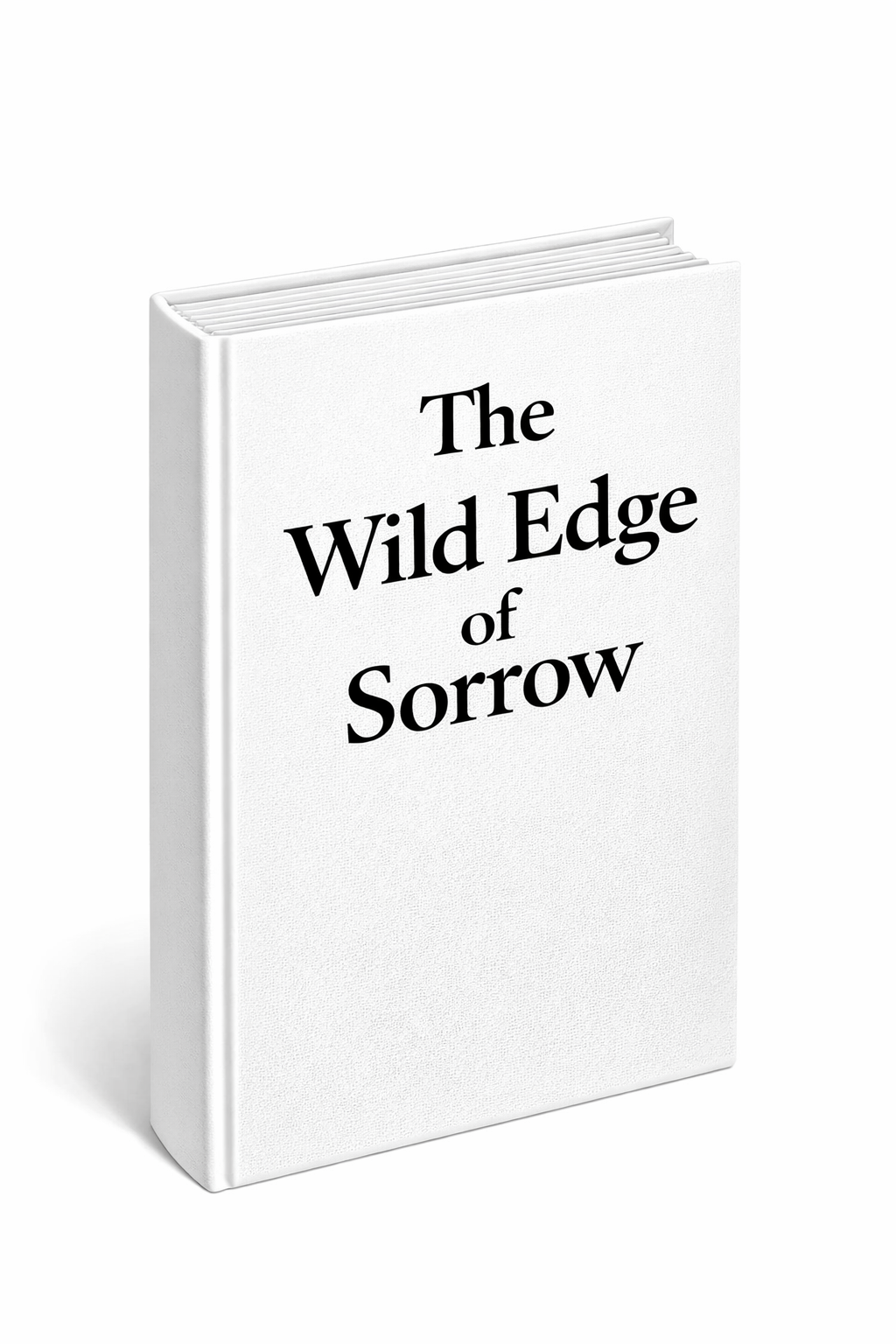
Much of what is shared here in this blog, and from the podcast I reference, comes from the book, “The Wild Edge of Sorrow”, by Francis Weller.
(*As an Amazon affiliate I may receive a small kickback from your purchases if you use my links.)
If you are trying to figure out where to start in prayer or grief work, you may want to check out my Recommended Reading list.
📌 As an Amazon affiliate, I may receive a small commission if you purchase through my links — at no extra cost to you. Thank you for supporting this blog!